Sacred Heart Hospital
Firefly LaneSacred Heart Hospital is the setting for several turning points in Kate and Tully’s lives: a medical examination that prompts an urgent breast ultrasound, the revelation that Kate’s inflammatory breast cancer has reached her brain, and the friends’ renewed closeness as treatment gives way to end-of-life care. The hospital’s clinical rooms and corridors hold both the force of medical intervention and the limits of what it can accomplish; in the end, the care that matters most is the friends’ decision to remain beside one another.
Diagnosis and Medical Attention
During a routine examination, Dr. Marcia Silver notices a quarter-sized red patch beneath Kate’s right nipple. Kate explains that it has been there for nine months, perhaps a year, and that it began like a bug bite. Her family doctor had treated it as an infection with antibiotics; it faded and returned, sometimes feeling hot. Kate adds that her mammogram had been clear. The discrepancy between reassuring imaging and a persistent, changing symptom sharpens the scene: a clean result has not explained what her body is showing.
Dr. Silver stops their impersonal small talk and immediately calls to arrange a breast ultrasound, asking that Kate be fitted in that day. Kate recognizes the alarm in the sudden change of tone and tells the doctor that she is frightening her. Dr. Silver does not diagnose her in the examination room; she says she hopes it is nothing, but wants to make certain. Sacred Heart thus enters Kate’s story as a place where a bodily sign that had been repeatedly mistaken for infection is taken seriously enough to trigger further investigation.
Tully’s Return
When Kate tells Tully that she is at Sacred Heart, on the fourth floor, the hospital becomes the destination of an urgent return. Tully presses her driver to hurry, runs through the glass entrance, and pushes past the people gathering around her. Recognition as a public figure cannot slow her: when the receptionist identifies her as Tallulah Hart, Tully asks directly for Kathleen Ryan’s room. She receives the room location, 410 East, and heads for the elevators despite the fans following her.
At the hospital, Johnny tells Tully that Kate has inflammatory breast cancer. Tully initially reaches for the familiar sequence of treatments she knows other patients have faced, asking about mastectomy, radiation, and chemotherapy. Johnny answers that Kate has already had them all. The news soon becomes more devastating: the cancer has metastasized, Kate has suffered a minor stroke, and surgeons discovered during the operation that there was nothing they could do. The cancer is in her brain. Tully’s guilt over the time she had not called meets a reality that cannot be reversed by arriving now, even as the hospital gives her the chance to be present from this point onward.
The Room and the Limits of Treatment
Before Tully enters Kate’s room, Johnny warns her that the cancer has affected Kate’s faculties. Kate has good moments and bad ones, and may not recognize her friend. The walk to the room feels to Tully like the longest journey of her life; surrounded by people speaking quietly, she nevertheless feels alone. At the doorway, Johnny stops, and Tully gathers herself before going in to see Kate asleep in bed. The warning makes the reunion uncertain, but it does not deter her from entering.
When they speak about what remains, Tully offers to call an Ontario doctor she knows from a breast-cancer program, who is working with a new drug. Kate says she is finished with treatment: she has tried it all, and none of it has worked. She asks Tully to be with her. This exchange marks a change in what the hospital can mean. It has been the site of examinations, procedures, surgery, and medical decisions; now Kate refuses another promise of rescue and names companionship as what she needs.
A Place to Stay Together
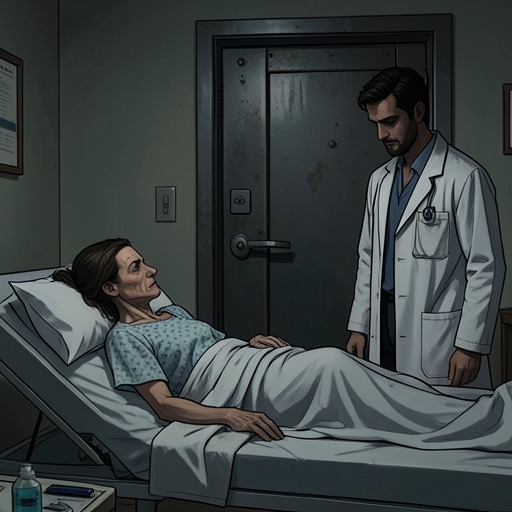
On Kate’s last night in the hospital, Tully persuades Johnny to take the children home and takes his place in the other bed in Kate’s room. She pushes the bed across the linoleum until it nearly touches Kate’s. The small rearrangement turns a clinical room into shared space: instead of standing at a distance or speaking across the room, the two friends can lie side by side as they once did as eighth-grade girls at a sleepover.
Tully brings a recording of her final television show and plays it for Kate. Their joking response to the choice of viewing does not erase the seriousness of the night; it allows their familiar friendship to persist within it. Sacred Heart holds both the news that treatment has failed and this intimate act of staying. It is not a cure, but the last hospital scene makes presence itself a form of care, sustained in the simple physical closeness of two beds pushed together.